
The Economics of PRRIA:
Facts and Fiction
Some very influential corporations and industry associations have collectively poured millions of dollars into lobbying efforts against the Packaging Reduction & Recycling Infrastructure Act (PRRIA) S.1464a / A.1749a. A common claim made by their ads and lobbyists is that PRRIA will drive up our grocery prices.
FALSE. It won’t, and it can’t. That math doesn’t work, and it’s not how their industry works either. They know this.
So, if you’ve been concerned about this rampant industry claim, then please know that it’s not true. They’re lying to us with million-dollar megaphones. PRRIA will not impact your grocery prices. Instead, it will greatly offset your local government’s municipal waste management costs, which may in turn reduce your property taxes, waste collection fees, or social service costs, or it may enrich your community in some other way depending on how your municipality reallocates their waste management savings from PRRIA.
If you want to understand this better, read on…
Why is PRRIA important to me?
Have you ever purchased something online and received a large box with multiple layers of plastic or paper packaging around a small product that already had its own box and packaging? You pay for the management of that waste. You pay through your waste collection fees, property taxes, or both. Currently, there’s little to no incentive for producers to reduce the amount of packaging they use, the types of plastic they use, or the toxic additives in the packaging. Their incentive is the cost of producing it.
Since before we were born, industry has been allowed to externalize these costs. PRRIA is an important step in changing that.
It’s also an urgent matter for our local economies. Packaging and paper represent about 40% of New York’s waste, and our landfills are maxing out. Multiple landfills will be closing next year, which will then drive up the costs of trash disposal. If New York fails to move forward with PRRIA another year, then that will be another year that we will not get reimbursed for our costs in managing this waste.
What would PRRIA cost manufacturers?
If passed, PRRIA will apply to only the largest manufacturers. They will pay an Extended Producer Responsibility (EPR) fee relative to the strain their packaging creates for our tax-funded waste management systems. The more packaging, the greater the fee. The more unrecyclable the packaging, the greater the fee.
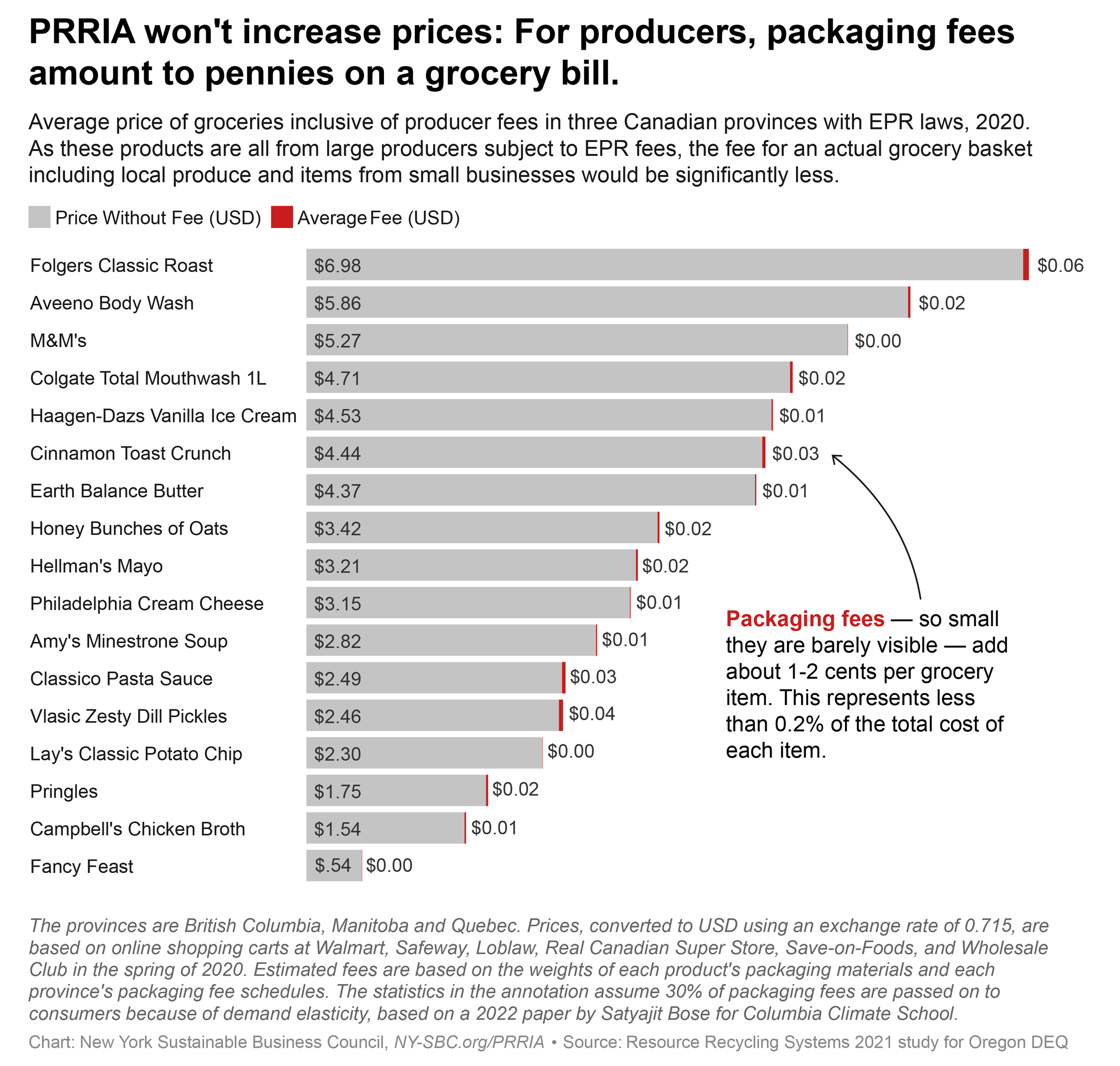
If you compare these fees directly to the number of products they sell, the cost is negligible. This bar chart – based on data from Canadian EPR programs compiled by Resource Recycling Systems – shows how small the EPR fees would actually be: as little as 9 to 31 cents on a typical grocery haul.
But even these small fees will not be passed through to New York consumers.
Won’t producers just raise New York grocery prices to recoup their EPR fees?
No. It would be very complex and too costly to modulate prices by state and even more so by fees like EPR that are so small and variable by state and year. Given all the corporate fear tactics on this subject, you deserve more information.
First, let’s be clear about how much EPR fees actually are. Revisit the bar chart above. The small amounts at the end of each bar would be the increase in grocery prices if producers could pass on 100% of New York’s EPR fees back to New Yorkers through their distribution pricing… but they won’t.
Producers set their prices to the global market or by country. The latter happens often where there are tariffs or other relevant trade costs for their products. As you know, we don’t have checkpoints at state borders. Products are distributed freely throughout the United States. Producers don’t control this.
For example, the largest food distributor in the world is Sysco Corporation. Sysco has well over 300 distribution centers serving nearly 100 countries. In the US, their distribution centers are not restricted by state lines. The Sysco that serves New York City plus Westchester county (nearly half of New York State’s population) is based in New Jersey. It also serves most of New Jersey and some of Pennsylvania.
The products in the chart above are distributed through food distributors like Sysco. The companies that produce those products won’t require distributors to add 2 cents to a product’s price when they distribute to restaurants and grocery stores in New York. The cost of managing such tiny price differentials would be higher than the cost of paying New York’s EPR fees. The industry simply doesn’t work that way within any single country.
Studies support this. For example, a 2019 National Bureau of Economic Research study found that most U.S. food, drugstore, and mass merchandise chains charge nearly-uniform prices across stores, despite widely differing consumer demographics and local competition.
If major factors like income disparities do not drive large manufacturers to change prices per jurisdiction, PRRIA’s tiny fees certainly would not.
What will PRRIA cost me?
Nothing, unless you’re a large corporation that sells packaged products in New York. In fact, PRRIA may actually save you money as explained below.
How will PRRIA benefit me?
PRRIA shifts packaging and waste management in ways that will reduce the pollution of our air, water, and other natural resources that our livelihoods depend on.
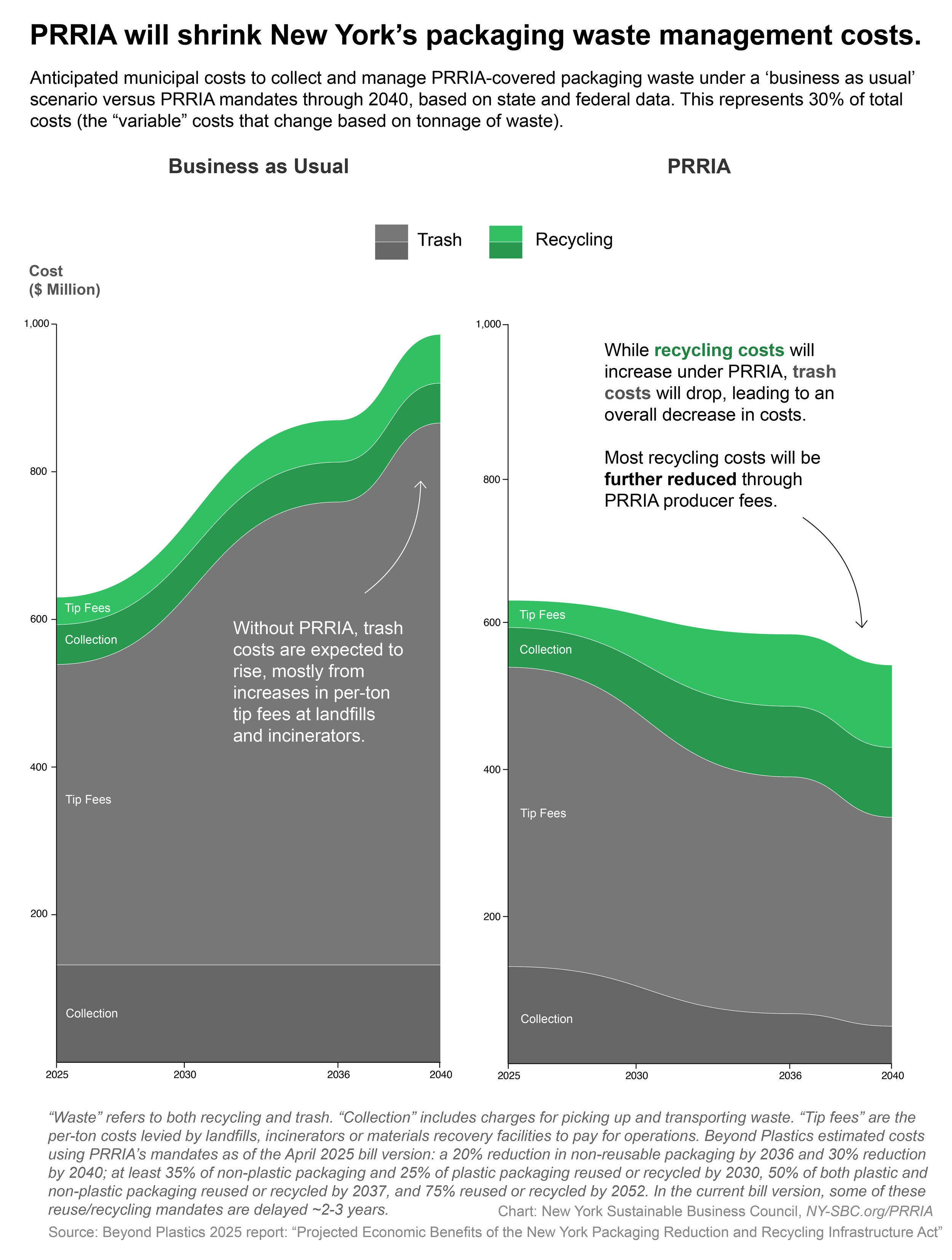
If you live in New York, PRRIA will also save local governments across our state roughly $568 million in reduced waste management costs in the next decade, according to a Beyond Plastics study. Much of the state’s packaging recycling costs – currently hundreds of millions of dollars – will also be reimbursed through EPR fees.
This chart shows New York’s projected savings in waste management.
How your local government reallocates those funds could mean reduced property taxes, waste collection fees, social service costs, or other benefits.
Then why am I seeing all these ads claiming that PRRIA will drive up my grocery prices?
PRRIA represents a paradigm shift that is all-to-slowly spreading around the U.S., though other parts of the world are already far ahead. Japan implemented packaging EPR in 1995. South Korea’s program has achieved high recycling rates. The EU passed recent laws requiring all 27 member states to establish EPR packaging schemes, and many countries, including Germany, France, Spain and the Netherlands, have run successful programs for years. Countries in Latin America and Africa have also passed EPR laws.
States across the US are waking up to this economic injustice and introducing EPR measures. Seven states have passed laws, and four more are considering them. Oregon’s program began operating last year. This collective movement represents a shift in industry responsibility that the biggest polluters vehemently oppose. Ultimately, the math for them is simple. The cost of their ads and lobbyists are less than their projected cost in accepting and complying with PRRIA, so they lobby against it.
What can I do to help?
Thank you! Here are two simple steps:
Call your Assemblymember today and say that you are a constituent (and business owner, if that is so) and that you’d like to see the Assembly pass A.1749a this year. That’s the Packaging Reduction & Recycling Infrastructure Act (PRRIA), and it died on the Assembly floor last year. We can’t wait another year!
Contact us at info@ny-sbc.org to learn how else you and your business can help us hold corporations responsible for the waste they produce.
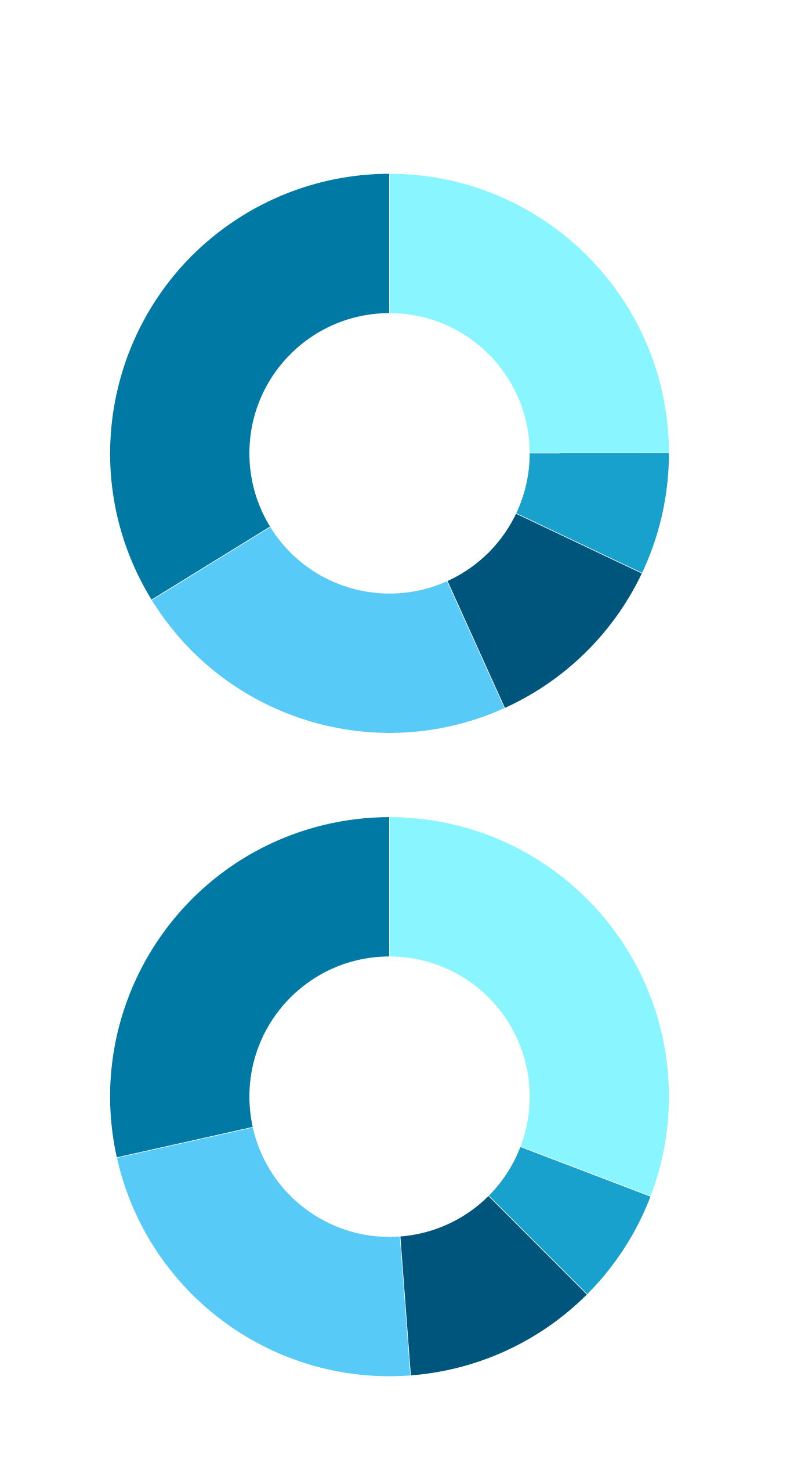
Oregon EPR revenue spending, past and planned
Oregon is the first U.S. state to operationalize an extended producer responsibility (EPR) program for
packaging. In the first six months (Q3-Q4 2025), Oregon collected $167.9 million in producer fees, about
$39 per resident, and spent about one third. Oregon's 2026 EPR revenue has not yet been released.
Spending in 2025
Other
Payments to
25%
Commingled
Recycling Processing
Facilities (CRPFs)
34%
$56.5 million
Regulatory
7%
Contamination
Reduction
Programming
11%
Start-Up Costs
23%
Planned spending in 2026
Payments
Other
to CRPFs
31%
29%
Program
Reserves
7%
Collection Services
90+ Drop-off
Expansion
RecycleOn Centers
23%
for PRO Acceptance
List
11%
The $111.4 million not spent in 2025 breaks into $60.2 million in operating reserves and $51.2 million earmarked for specific
2025 activities (collection expansion, contamination reduction, and similar) expected to roll into 2026–2027 spending.
Chart:
New York Sustainable Business Council, NY-SBC.org/PRRIA
Source:
Circular Action Alliance

Oregon EPR revenue spending, past and planned
Oregon is the first U.S. state to operationalize an extended producer
responsibility (EPR) program for packaging. In the first six months (Q3-Q4
2025), Oregon collected $167.9 million in producer fees, about $39 per
resident, and spent about one third. Oregon's 2026 EPR revenue has not
yet been released.
Spending in 2025
Payments to
Other
25%
Commingled
Recycling Processing
Facilities (CRPFs)
34%
$56.5 million
Regulatory
7%
Contamination
Reduction
Programming
11%
Start-Up Costs
23%
Planned spending in 2026
Payments
Other
to CRPFs
31%
29%
Program
Reserves
7%
Collection Services
90+ Drop-off
Expansion
RecycleOn Centers
23%
for PRO Acceptance
List
11%
The $111.4 million not spent in 2025 breaks into $60.2 million in operating reserves and $51.2 million
earmarked for specific 2025 activities (collection expansion, contamination reduction, and similar) expected
to roll into 2026–2027 spending.
Chart:
New York Sustainable Business Council, NY-SBC.org/PRRIA
Source:
Circular Action Alliance
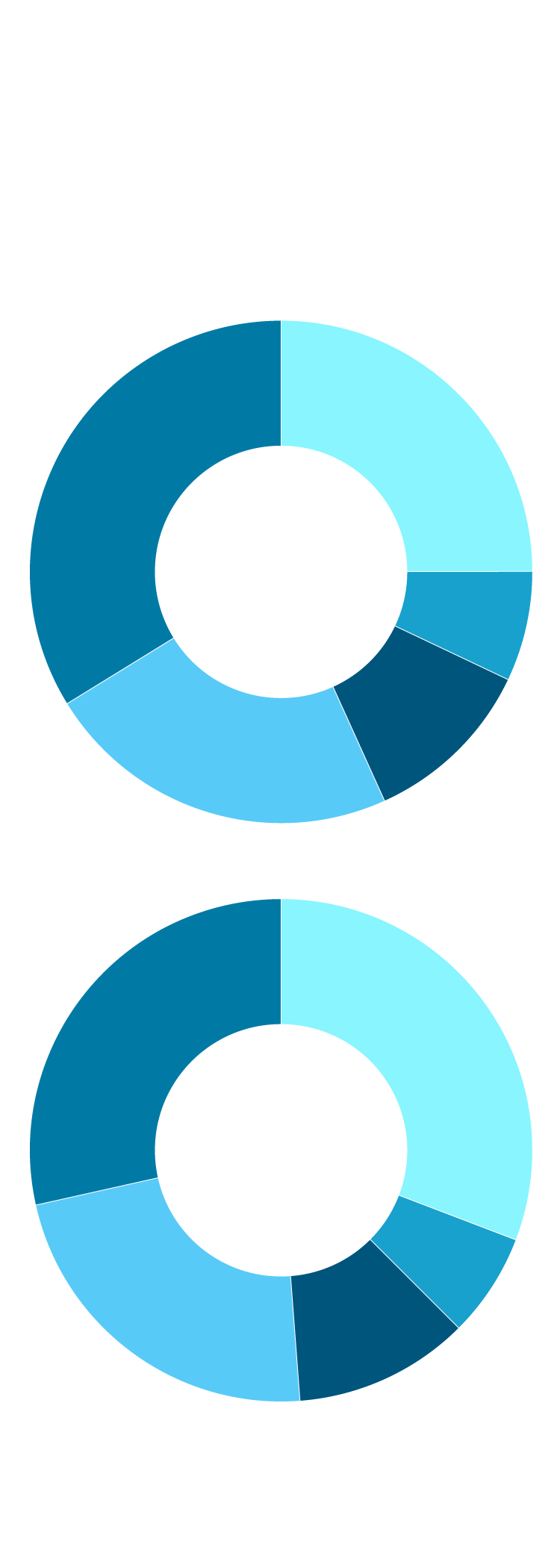
Oregon EPR revenue spending,
past and planned
Oregon is the first U.S. state to operationalize an
extended producer responsibility (EPR) program for
packaging. In the first six months (Q3-Q4 2025), Oregon
collected $167.9 million in producer fees, about $39 per
resident, and spent about one third. Oregon's 2026 EPR
revenue has not yet been released.
Spending in 2025
Payments to
Other
25%
Commingled
Recycling Processing
Facilities (CRPFs)
34%
$56.5 million
Regulatory
7%
Contamination
Reduction
Programming
11%
Start-Up Costs
23%
Planned spending in 2026
Payments
Other
to CRPFs
31%
29%
Program
Reserves
7%
Collection Services
90+ Drop-off
Expansion
RecycleOn Centers
23%
for PRO Acceptance
List
11%
The $111.4 million not spent in 2025 breaks into $60.2 million in operating
reserves and $51.2 million earmarked for specific 2025 activities (collection
expansion, contamination reduction, and similar) expected to roll into 2026–
2027 spending.
Chart:
New York Sustainable Business Council, NY-SBC.org/PRRIA
Source:
Circular Action Alliance